

A useful weekly review can take ten minutes: notice one thing that actually worked, name one place your plan met friction, and choose one small experiment for the week ahead. You do not need to grade yourself, rebuild your whole routine, or buy a special planner. The point is to turn a fuzzy week into one clear observation and one next move.
This is a short reset for a busy week—not a productivity scorecard. Keep it on any page you can find again, on paper or digitally.
What is a weekly review?
A weekly review is a brief look back at what happened, followed by a practical adjustment. The University of Wisconsin–Stevens Point's weekly-planning template asks learners what they completed, where their plan did not match reality, and what they will adjust next. Princeton's McGraw Center frames a related cycle as intend, reflect, and revise. Those are useful prompts, not rules: your review can be shorter and about ordinary life as much as school or work.
Use the Notice–Name–Narrow method
1. Notice one concrete thing that worked
Write one observable detail, not a verdict about yourself. “I brought lunch twice” is easier to use next week than “I was good.” “I called the dentist after lunch” is more useful than “I got organized.” A specific note gives you something real to keep, repeat, or change.
2. Name one friction point without blaming yourself
Ask where the plan met real life. Did an errand take longer than the time available? Did you lose a reminder because it lived in three places? Did a task need information you did not have yet? Naming the condition matters more than assigning fault.
3. Narrow the response to one experiment
Choose one adjustment that is small enough to try once: add a buffer before an appointment, write a task's first action beside it, or keep a shopping list by the door. Do not turn one difficult week into a demand to fix every habit at once. Next Friday, you can simply see whether the experiment helped.
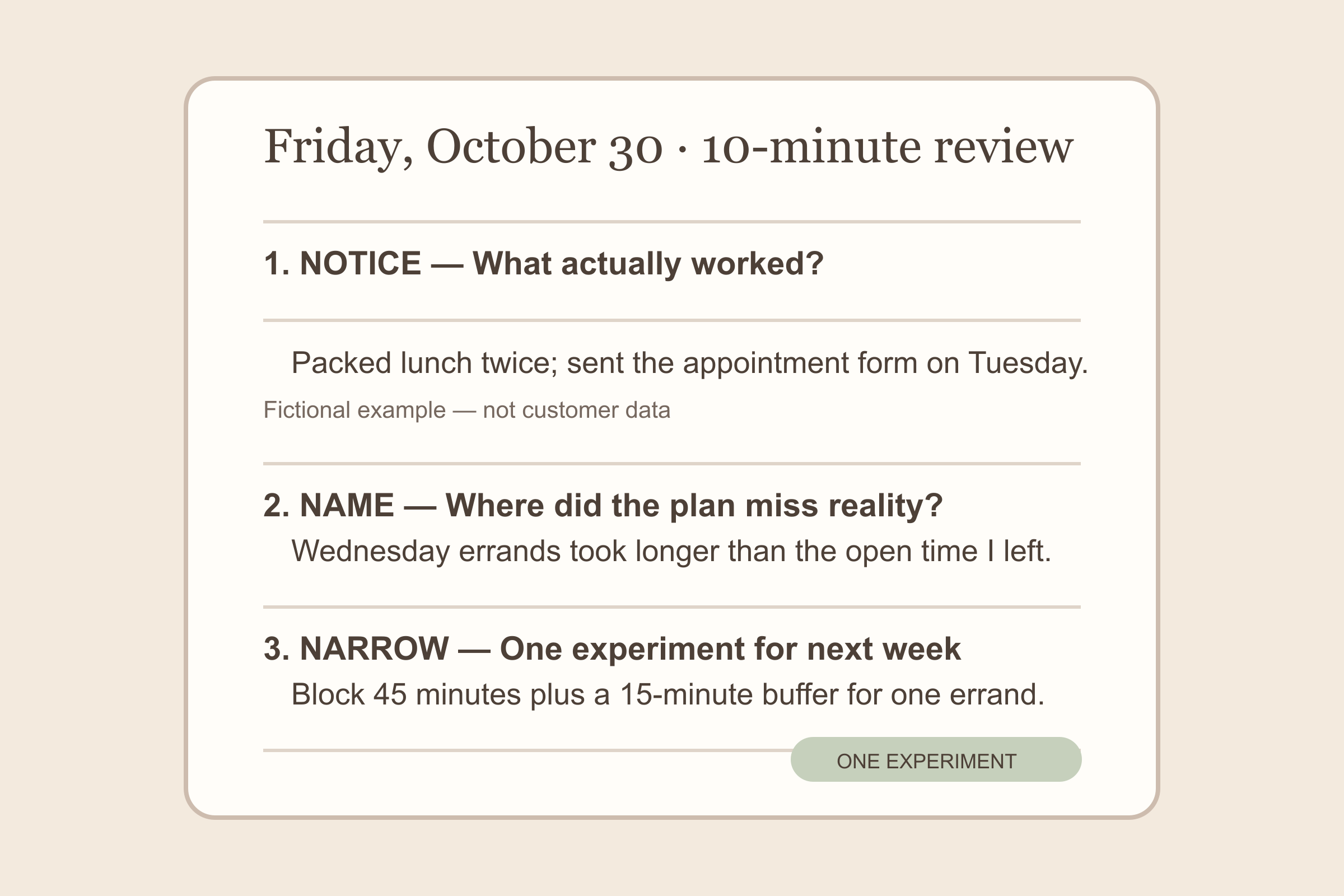
A 10-minute weekly review, step by step
- Set a small timer. Ten minutes is enough. Stop when it ends; this is not a life audit.
- Look at the evidence you already have. Your calendar, task list, receipts, or messages can jog your memory. Do not copy private details you should not carry.
- Write one line for each prompt. Notice, name, and narrow. Leave the rest blank if nothing comes up.
- Put the experiment where next week begins. Add it to a calendar, next-action list, or the top of the next note page.
Example: when a week did not go as planned
Fictional example: Maya planned to run two errands Wednesday evening. One store was closed early, so the trip took longer and dinner happened late. Her review is not “I failed at planning.” It is: Notice: I completed the appointment form Tuesday. Name: Wednesday errands had no buffer. Narrow: next week, I will schedule one errand in a 45-minute block plus 15 minutes of extra time.
That experiment may or may not fit Maya's next week. The useful part is that it is specific and testable, rather than a promise to “be better.”
Put the review on a page you will reopen
A lined page works well when you want a few complete sentences rather than another grid to fill. JOYJOY Soft Ruled Notes Planner Inserts have 6 mm lines and are offered in M5, A7 / Pocket, A6 Personal, and A5. They are optional—any notebook works. If you use a ring planner, choose the exact size and hole pattern that already fits your cover.

A simple lined page for a short weekly review, notes, and next-week experiments.
Current checked prices: M5 $4.99 · A7 $5.99 · A6 Personal $6.99 · A5 $7.99. Recheck before publishing.
See Soft Ruled Notes →Keep the weekly review small
- Do not use it as an archive. Keep private account numbers, confidential work details, and sensitive personal information elsewhere.
- Do not force a lesson from every hard week. Sometimes the only honest note is that the week was unusually full.
- Pair it with the right rhythm. Use a monthly life-admin check for bills, appointments, and dates that belong on a longer cycle.
- Use the system you will reopen. If a ring planner suits you, learn how planner inserts work before choosing pages and sizes.
Frequently asked questions
How long should a weekly review take?
Try ten minutes. A short, repeatable review is more useful than a long session you avoid. If you want to keep going, save deeper planning for another time.
What if the week went badly?
Start with a factual line about what made the week hard, then choose no experiment or one very small one. A review is not proof that you should have controlled every circumstance.
Do I need a special planner page?
No. Use a notebook, digital note, or any page you can find again. A ruled insert is helpful only if keeping the review with your other planning pages makes it easier to revisit.
Method note: the University of Wisconsin–Stevens Point and Princeton McGraw Center materials informed the general review-and-adjust structure. They do not test or endorse JOYJOY products. This article offers general organizational ideas, not medical, mental-health, financial, or workplace advice.